
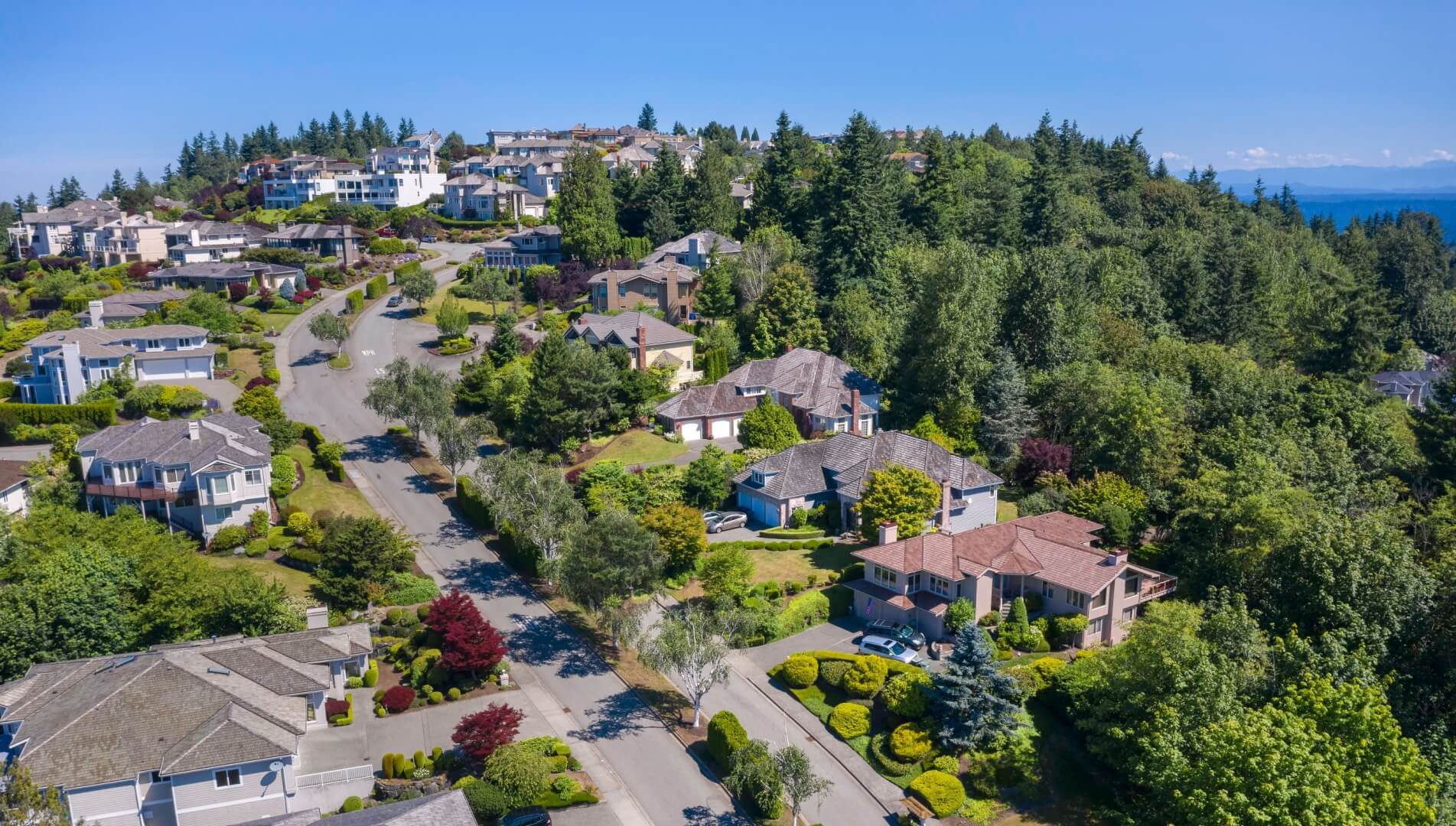
- In Washington, 36% of residents rent their homes, after the number of renter households increased by 4.5% compared to 2018.
- From owner havens to renter oases: In Seattle, three of the nine main cities in the metro are dominated by renter households and six of its 66 largest suburbs have more renters than owners.
- The number of renter households increased in 37 of the 66 most populous suburbs, sometimes by as much as 85% (Newcastle) and 72% (Edgewood and Lake Stickney).
- Of the six renter-dominated suburbs in the Seattle area, only Sumner switched from owner- to renter-majority since 2018.
- Although the state as a whole and Seattle’s main cities and suburbs remain owner-dominated, the move toward renting is taking off.
203 Suburbs Across U.S.’S 20 Largest Metros Are Now Dominated by Renters
A recent Point2Homes analysis of U.S. Census data reveals that out of nearly 1,500 suburbs with populations exceeding 10,000 across America’s 20 largest metropolitan areas, 203 have transitioned to renter-majority communities.
In these suburbs, more residents lease their homes than own them, a newer housing trend that seems to be rooted in the affordability issues and the need for more space and flexibility of a growing number of renters.

Of these, Seattle metro claims six. It’s worth noting, however, that Fort Lewis is an exception, as military bases and army installations have the highest shares of renter households no matter the larger housing trends.
That leaves Tukwila (59.6% renter households); SeaTac (54.9%); North Lynnwood (54.5%); Fife (53.5%); and Sumner (50.2%) as the only suburbs that truly are renter-majority communities. In fact, Sumner is the newest addition to the list, as it became a renter-majority suburb in the short span between 2018 and 2023.
This may not sound like much, but it’s proof that a housing shift is underway. Historically, suburbs were homeowner strongholds, symbols of the American dream of homeownership and a clear new milestone marking the departure from the crammed, urban, rental lifestyle. But this is clearly changing, as renting becomes more prevalent in suburban areas as well.
Although they aren’t yet renter-dominated, many Seattle suburbs have seen their number of renter households go up in recent years. In fact, there are more suburbs where renters increased than suburbs where their numbers dwindled.
In Newcastle, the number of families who rent their homes went up 85.2% from 2018 to 2023. Renter households in Edgewood and Lake Stickney have seen similarly impressive jumps, increasing by around 72% during the same timeframe. Bothell East is the only other suburb where households who rent jumped by more than 50%, but in 20 more suburbs renters increased significantly.
Why Are Suburbs Becoming Renter-Dominated?
Although this is by no means a sweeping trend and homeownership is still the main way to exist in the suburb, the fact that more and more people think about renting their share of the suburbia rather than buying it speaks volumes about the changes on the housing market.
This preference has been amplified by the prohibitive costs in the for-sale housing market, including skyrocketing home prices, high interest rates, and steep down payments. With rising living costs, student loans, and an unpredictable economy, many renters are looking for ways to keep their options open. Renting can make more sense than buying, since it frees up money for other priorities. So, as ownership becomes increasingly out of reach for many, renting in the suburbs emerges as a more feasible and financially sensible option.
What’s more, the shifting life stages among key demographics have an impact as well. Millennials, now entering their peak family-raising years, are seeking larger homes with more space for children, home offices, and outdoor amenities — features more readily found in the suburbs than in urban cores.
At the same time, Baby Boomers and empty nesters are opting to downsize from long-held homes, favoring the convenience, reduced maintenance, and family proximity that suburban rental properties can provide.
Finally, the rise of remote work has made suburban living more attainable and desirable. As many professionals can now work from home, they can relocate from high-cost urban centers to more affordable and spacious suburban areas without sacrificing employment opportunities.
Washington Among Top 20 States with Highest SFR BTR Inventories, as More Than A Third of People Are Renters
Population migration trends in the past several years increasingly reflect a move toward secondary cities and suburban communities, where residents can enjoy a better balance of affordability and livability.
And Washington is no exception. The state continues to experience steady population and household growth, placing ongoing pressure on affordability, as well as housing supply.
As of 2023, the state’s population reached 7,740,984. Similarly, over the past five years, the total number of households increased from 2.8 million in 2018 to just over 3 million in 2023 — an addition of more than 220,000 households, reflecting a growing demand for diverse and flexible housing options and increasing the pressure on housing development.
While homeownership has seen a modest rise — increasing from 62.7% in 2018 to 63.9% in 2023 — 36.1% of Washingtonians still rent their homes, underscoring the importance of high-quality rental housing in the state’s broader housing ecosystem.
Within this context, single-family rentals have emerged as a growing segment in Washington’s real estate market. Designed specifically for long-term renters, BTR communities offer more than just a home: With many of the rentals coming with modern appliances and home features better suited to the modern renter, the shared amenities, like pools, gyms and sports courts or pet parks are a big plus.
Between 2018 and 2023, the number of completed BTR units in Washington increased from 3,285 to 4,372, with notable growth in 2021 and 2022. By the end of 2025, the state is projected to have 4,570 completed BTR units across 40 communities, with 281 additional units currently under construction.
Of the 4,570 BTR homes in the state, nearly 2,500 are in Seattle alone. Spokane and Olympia also have a couple hundred single-family rentals, with Kennewick, Bremerton and Yakima contributing more modest inventories to the total BTR supply in the state.
Bremerton, however, stands out in another area: It’s the only metro where developers are currently working on adding new inventory. No fewer than 170 rental homes are under construction here.
Zooming in on Seattle Metro, three principal cities (Seattle, Lakewood, Redmond) are renter-majority — with the population in Everett split equally between renters and owners, and Bellevue looking like it’s fast approaching a tipping point. This could mean that more, and more varied housing for renters might become a must in the near future.
As Washington continues to grow, BTR housing represents an increasingly relevant solution for renters seeking quality homes without the commitment of ownership — bridging the gap between traditional apartments and homeownership in a fast-evolving market.
Methodology
Point2Homes.com is a real estate listing portal for rental homes across the United States. Part of Yardi Systems, Point2Homes covers housing trends and news through comprehensive studies that draw from internal data, public records, governmental sources, and online research.
- For this study, we took into consideration the 20 largest U.S. metros by population, as well as suburbs with at least 10,000 residents.
- Data source: U.S. Census Bureau, ACS five-year estimates for 2018 and 2023.
- Numbers reflect changes in the number of households.
- For the purpose of this report, urban areas are considered to be principal cities as defined by the Office of Management and Budget. All others are considered suburban areas.
- Suburban mapping was completed using U.S. Census Bureau geographical definitions to identify suburbs in metropolitan areas across the nation, excluding the core cities.
- This study is exclusively based on data related to build-to-rent communities containing at least 50 single-family rental units, located in build-to-rent, professionally managed communities in the markets covered by Yardi Matrix research. This analysis does not include other types of single-family rentals that are not located in build-to-rent communities.
- Yardi Matrix data as of March, 2025 was used throughout the report. Data for some markets may not be available and data for the locations included in the analysis may be subject to change.
- Build-to-rent communities are defined by Yardi Matrix as communities where at least 50% of the units fit one of the following criteria: (1) They do not share any walls with other units, or (2) they have shared walls, but do not have neighbors above/below or have a direct-access garage.
- For the purposes of this study, we considered as “completed in 2024” only units that received a certificate of occupancy by the end of December 2024. Units under construction either have not yet received an official certificate of occupancy or are currently being built. Under construction data may be incomplete and is subject to change.
- Image credit: Ryan C Slimak / Shutterstock.com
Fair use and redistribution
We encourage and freely grant permission to reuse, host or repost this article. When doing so, we only ask that you kindly attribute the authors by linking to Point2Homes.com or this page, so that your readers can learn more about this project, the research behind it and its methodology.
