
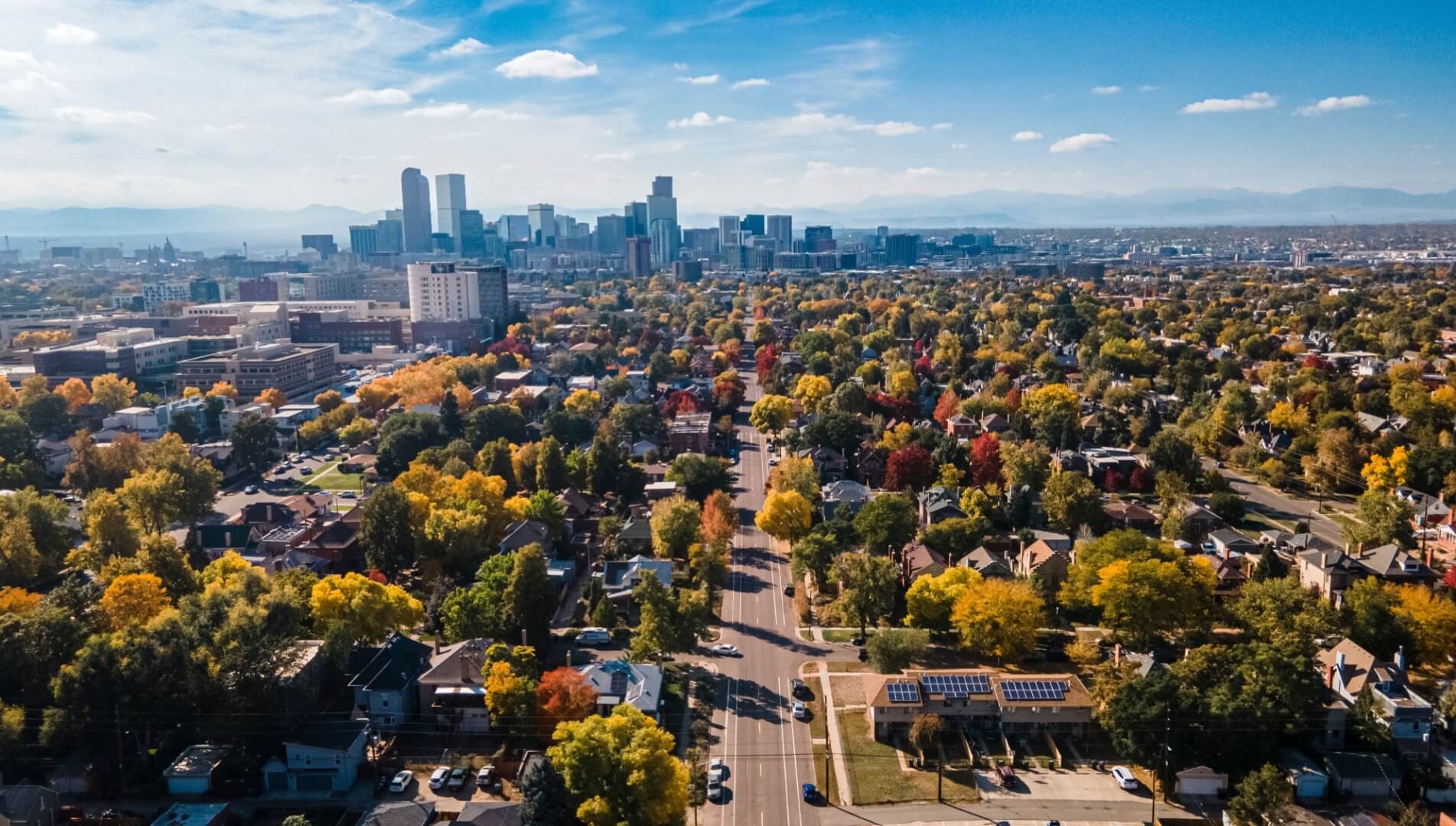
Key Highlights
- In five years, 16 of 26 Denver suburbs added renter households, led by Castle Pines with a surge of nearly 89%.
- Westminster, Parker, Lakewood, and Castle Rock each added over 1,000 new renter households.
- Englewood is now the only renter-majority suburb in the Denver metropolitan area: Over 52% of its households rent, supported by transit and opportunities that come with proximity to Denver proper.
- Some suburbs moved in the opposite direction: The Pinery and Cherry Creek both significantly diluted their renter share, yet didn’t experience significant increases in ownership in return.
- Denver is the only renter-majority principal city in the metro, with almost 51% of households being renters.
- Suburbs outpaced cities in build-to-rent house supply: By 2025, Denver suburbs completed 1,508 new single-family units versus 1,283 delivered in the metro’s urban areas.
- Colorado ranks 8th for future SFR BTR deliveries: With 2,791 single-family rentals in the pipeline, build-to-rent options are reshaping rental demand — just in time, as rentership has increased statewide.
A recent Point2Homes study revealed that U.S. suburbs are increasingly becoming renter territory. Across the 20 largest metropolitan areas, nearly 1,500 suburbs have populations over 10,000 — and in 203 of them, renters now outnumber homeowners, according to recent U.S. Census data. In these communities, leasing has officially surpassed owning as the most common way to live.
With the boundary between city and suburb fading, the Denver–Aurora–Centennial metro and its communities make for an interesting case. Affordability pressures, greater mobility, and shifting lifestyle preferences are pushing rental demand outward, making homes for rent a common feature far beyond city limits.
From fast-growing suburbs like Castle Pines and Parker to long-established big communities like Westminster and Lakewood, renters are steadily gaining ground. Yet, a closer look at recent Census figures shows more Coloradans choosing to lease rather than buy in some areas, while in others, ownership remains the name of the game. All while the metro reflects a broader national trend: more and more single-family houses are being built specifically to rent.
Most Denver Suburbs See Growth in Renter Households
Englewood, the metro’s only renter-majority suburb
In five years, suburbs across the Denver-Aurora-Centennial metropolitan area revealed mixed housing trends, with some communities adding thousands of new renter households, while others were losing hundreds. Still, 16 in 26 suburbs experienced a rise in renter households:
Percentage-wise, Castle Pines led all suburbs with an 88.7% increase in renter households — the largest suburban renter growth metro-wide. Long regarded as one of Colorado’s most desirable suburbs, the area is known for good schools, green space, and an abundance of lifestyle amenities. While Castle Pines remains predominantly owner-occupied (owner households here also rose by nearly 21%), efforts have been made to pursue a variety of housing options and broaden its appeal to renters as well.
Meanwhile, latest data points to four of the metro’s largest and fast-developing suburbs each added over 1,000 renter households in five years, evidence of growing demand for rentals in well-connected, commuter-friendly communities:
- Westminster: +2,009 renter households
- Parker: +1,889 renter households
- Lakewood: +1,568 renter households
- Castle Rock: +1,065 renter households
On the other hand, The Pinery recorded the sharpest decline, shedding 207 renter households (-61%). In contrast, owner households in the suburb grew, albeit modestly. The community remains predominantly low-density and master-planned, characterized by large single-family homes and limited multifamily or rental stock. Its reputation as an upscale, tight-knit, and tranquil enclave (with spacious lots, natural beauty, and excellent schools) further attracts long-term homeowners over renters.
Minutes away from Downtown Denver, Englewood stands out as the only renter-majority suburb in the metro, with 52.3% of households renting — a majority held since at least 2018. Nowadays, that translates to 8,530 renter households compared to 7,777 owners. Despite being on the smaller side, Englewood’s continued renter dominance is mostly due to strong transit access and proximity to central Denver.
Urban Rentership Holds Steady: More Renter Households Across the Metro’s Principal Cities
Denver proper cements its status as renter-majority city
The suburban renter boom is only half of the picture. While many Denver-area suburbs are seeing renter households surge — in some cases even outpacing the renter growth seen in urban areas — the metro’s urban centers remain the backbone of rentership.
Together, the cities of Denver, Aurora, Centennial, Broomfield, and Commerce City account for nearly 244,300 renter households. Suburbs, by comparison, counted nearly 148,350, a substantial number, but still secondary to the dense, renter-heavy strongholds of Denver proper or fast-growing Broomfield.
Across these five main cities, renter household numbers are rising, but not uniformly. Only Denver stands out as the metro’s sole renter-majority city, where more than half of all households lease rather than own.
The state capital added a remarkable 19,400 renter households between 2018 and 2023 — reaching a total of 167,670. But what makes Denver truly exceptional is its dual growth: not only did renter households surge, but the city also added 15,800 owner households in the same period, pointing to residential demand and population growth overall.
Aurora is a pretty renter-heavy core, too, drawing those who prioritize proximity to jobs, transit, and amenities. Still, the modest 15 renter households that popped up in the city point to stagnation rather than structural change. This may indicate that people are beginning to migrate outward, either for affordability, space, or alternative housing options around the main hubs.
One of the places renters might consider moving to? Broomfield. Once more closely associated with ownership, the city added almost 2,570 renter households — the second-largest gain after Denver. This uptick likely reflects Broomfield’s evergreen outdoor appeal, but also potential as a live-work community thanks to its proximity to job opportunities.
Centennial is the metro’s most owner-heavy principal city. But even here, rentership is gaining ground, with an 11.5% rise in renter households compared to a 3% increase in owner households. Its reputation as a stable, family-oriented city with good schools still favors ownership, but the gains in renters show a modest opening for younger households and more flexible living.
Colorado’s Build-to-Rent Market Expands
Denver metro is responsible for delivering the bulk of the state’s purpose-built house rentals
Colorado witnessed a 5.5% bump in renter households — the fifth-largest among all 50 states — making purpose-built rentals a vital piece of its housing puzzle, as demand and desirability are no longer concentrated in multifamily complexes alone. Rather, renters are increasingly seeking detached homes in professionally managed communities.
Among all U.S. states, Colorado ranks 20th for completed build-to-rent single-family rentals, with 3,791 units delivered. At the same time, it ranks as the 8th state by number of such rentals currently in the pipeline: 2,754. That translates to 30 completed communities and 16 others underway, placing Colorado far ahead of its regional neighbors, including Oklahoma, Nebraska, Wyoming, and New Mexico.
The Denver metro accounts for the majority of the state’s SFR BTR activity, with nearly 2,800 completed units across 22 communities. As renter households have steadily increased in the metropolitan area (7.7% more renter households in five years), this demographic shift has driven up demand for more space and flexibility — making single-family rentals an increasingly attractive alternative. These purpose-built communities are now a defining feature of the metro’s expanding rental inventory, reshaping how and where Coloradans rent.
1,500+ New Single-Family Rentals Outside Denver’s Urban Core
While renters are mostly concentrated in the urban areas of the Denver–Aurora–Centennial metro, the future growth in rental supply is tilting suburban. As families and would-be buyers are priced out of the city but still seek space, amenities and options, demand is shifting — and developers are following it.
This is especially evident in the build-to-rent single-family rental sector. By 2025, the suburbs have out-delivered in completions: 1,508 units were completed in suburban compared to 1,283 in urban communities. Last year alone, suburbs put 78 new units on the ground compared to 68 across the metro’s urban areas.
The projects currently in the pipeline reinforce this momentum. The suburbs are preparing to welcome four new rental communities, same as in the urban areas of the metro. While the scale of units differs slightly (685 units planned for the principal cities versus 536 in the suburbs), the close race highlights how suburbs are closing the gap and emerging as a stronger engine for new rental housing.
Methodology
Point2Homes.com is a real estate listing portal for rental homes across the United States. Part of Yardi Systems, Point2Homes covers housing trends and news through comprehensive studies that draw from internal data, public records, governmental sources, and online research.
- For this study, we initially took into consideration the 20 largest U.S. metros by population, as well as suburbs with at least 10,000 residents.
- We analyzed Colorado, focusing on its largest metro area (Denver-Aurora-Centennial), suburbs, and principal cities, focusing on changes in the number of renter and owner households between 2018 and 2023, based on U.S. Census Bureau ACS 5-Year Estimates.
- For the purpose of this report, urban areas are considered to be principal cities as defined by the Office of Management and Budget. All others are considered suburban areas.
- Suburban mapping was completed using U.S. Census Bureau geographical definitions to identify suburbs in metropolitan areas across the nation, excluding the core cities.
- BTR data includes communities with at least 50 single-family rental units, professionally managed and purpose-built for rent.
- Data focuses on completed units (those with certificates of occupancy as of December 2024), and pipeline projects (under construction or planned developments). Under construction status is determined by the start of vertical construction, not site preparation (horizontal construction). Planned developments have received full municipal approval but have not yet broken ground.
- Only properties meeting Yardi Matrix’s BTR definition were included — meaning at least 50% of units are either fully detached homes with no shared walls or units with shared walls but no neighbors above/below and a direct-access garage.
Image: Kevin Carpenter/Shutterstock.com
Fair use and redistribution
We encourage and freely grant permission to reuse, host or repost this article. When doing so, we only ask that you kindly attribute the authors by linking to Point2Homes.com or this page, so that your readers can learn more about this project, the research behind it and its methodology.
