
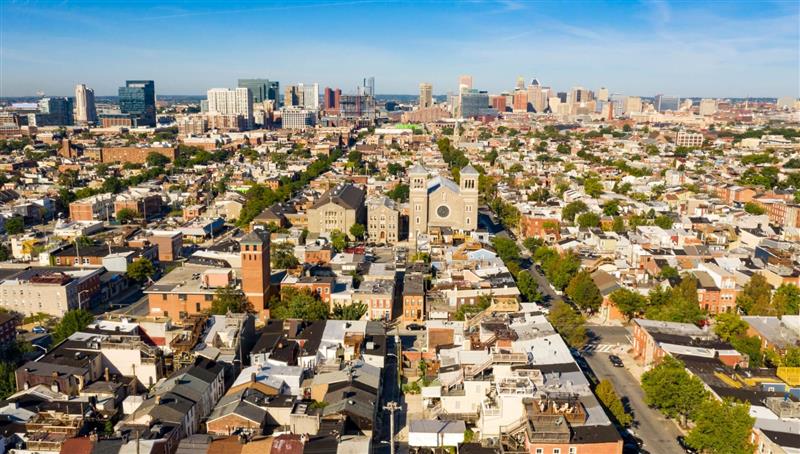
- In Maryland, 32.5% of residents rent their homes, after the number of renter households increased by 4.4% compared to 2018.
- 21 of the state’s largest suburbs currently have more renters than owners, in what seems to be a complete departure from old ownership trends, whereby the suburb is definitive homeowner territory.
- What’s more, the number of renter households increased in 75 of the state’s 118 most populous suburbs, sometimes by as much as 207% (Scaggsville) and 122.5% (Mays Chapel).
- In Baltimore, two cities and five large suburbs within the metro area have more renters than owners, meaning they are dominated by renter households.
- Of the five renter-dominated suburbs in the Baltimore area, only Garrison switched from owner- to renter-majority since 2018.
In a recent study carried out by Point2Homes, no fewer than 203 suburbs in the 20 largest U.S. metros were found to now be renter-majority. In these areas, there are more people renting their homes than residents owning them.
This highlights an unprecedented shift in housing habits across the country. Suburbs were once almost exclusively home to owner-occupied households, a place for people to settle down and get a foot on the property ladder.
However, a mix of rising costs and changing work habits has seen people who might once have considered buying a home continuing to rent, regardless of age or status.

Majority of Baltimore Renters Live in Suburbs, Not the City
In the past, city dwellers tended to rent, while those in the suburbs were more likely to own. As the suburbs grow and populations increase, more rental opportunities in the suburbs also seem to have appeared.
In Baltimore, this trend has been in full force for several years. While homeownership has seen a very modest rise — increasing from 66.4% in 2018 to 66.9% in 2023 — 33.1% of Baltimore’s residents still rent their homes, underscoring the importance of high-quality rental housing in the state’s broader housing ecosystem.
And of all the people in Baltimore who lease their homes rather than own it, the majority live in the suburbs. This suggests that renter-friendly homes are creeping out of the inner city hub and into the suburbs. Nearly 54% of Baltimore renters now rent a home in the suburbs, which means that only around 46% of renters are city-bound.
In fact, 21 Maryland suburbs, five of which are in Baltimore metro, are dominated by renters, not owners:
What’s more, the number of renter households in the suburbs is growing faster than in the city. Between 2018 and 2023, renter households rose from 171,683 to 181,424 in Baltimore’s suburbs, an increase of 5.7%. During the same period, the number of renter households in Baltimore’s urban neighborhoods increased by 5.2%. As a result, renter growth in suburban Baltimore outstripped the city by 0.5%.
While the difference is rather small, it’s a strong indication that housing options are gradually leaning more towards renters in Baltimore’s suburbs as the population booms and affordable housing becomes ever-more limited. While fewer people are able to buy a home, many still crave the suburban lifestyle, especially young families.
5 Baltimore Suburbs Where Renters Outnumber Owners
1. Fort Meade, MD
Fort Meade is a military base located on the southwestern edge of the Baltimore Metropolitan Area. Home to all 5 branches of the U.S. Military (Army, Air Force, Coast Guard, Marines, and Navy), it’s a bustling area, with a total of 3,093 households according to the 2023 census. Of those, 3,068 are renter occupied, resulting in a renter share of 99.2%. This puts Fort Meade in the number one spot of all the U.S. suburbs studied.
As a military base, this isn’t necessarily a true reflection of the housing market in Baltimore, however. Indeed, the top 3 suburbs in the study were all military bases, all with an almost 100% share of renters.
2. Cockeysville, MD
Situated at the extreme northwest tip of Baltimore’s Metropolitan Area, Cockeysville boasts 10,471 households. Of these, 6,833 are renter occupied, a share of 65.3%. Famous for its high-quality marble, which can be found in the Washington Monument and countless buildings in the region, including the United States Capitol Building, the suburb takes the number 50 spot in the overall ranking.
3. Milford Mill, MD
Located approximately 15 miles northwest of downtown Baltimore, Milford Mill is a relatively large, predominantly residential suburb. The suburb boasts 11,881 households, of which 55.5%, or 6,593, are renter-occupied. The bulk of the homes in Milford Mill are single-family houses, indicating an increase in renters who prefer a house over an apartment.
4. Owings Mills, MD
Hot on the heels of Milford Mill, Owings Mills boasts a renter share of 54.6%, putting it in 141st place in the overall rankings. Located just north of Milford Mill, Owings Mills is slightly smaller in terms of square footage, but boasts more households, with a total of 14,161, 7,736 of which are renter-occupied. The suburb boasts a mix of housing options, including single-family homes, townhouses, and small apartment blocks. Beyond residential dwellings, Owings Mills is also home to several commercial areas, including Mill Station Retail Park.
5. Garrison, MD
Sitting just south of Owings Mills, Garrison is a slightly smaller Baltimore suburb that enjoys tree-lined streets, with most of the households in the area being townhouses and single-family homes. It has 3,785 households in total, 1,898 of which are renter occupied for a share of 50.1%.
Rossville Almost Makes the Grade
Rossville is a fairly large suburb sitting northeast of the city proper. With a renter share of 49.8% it doesn’t quite make the list, and owner-occupied households still just about dominate. However, if trends continue, there’s a good chance the balance could shift in the coming years.
What Is Driving the Increase in Renter Households in Baltimore?
There are many reasons why planners and developers have taken to providing rental opportunities in Baltimore’s suburbs. Chief among these is the fact that demand for rental homes has been on the rise for the last decade or so, with events such as the pandemic making renting a safer, more reliable option.
There’s no doubt that house prices are higher than ever. Potential homeowners need a huge deposit and excellent credit to even contemplate buying. Add in the high interest rates, increasing costs of maintenance, and it all becomes extremely expensive and risky.
But it’s not just for financial reasons that more and more people wish to remain renting. Work habits have shifted significantly in recent years, with more people than ever able to work remotely. Renting offers a type of flexibility that ownership could never compete with.
That’s not to say that renters want to continue to live in the hustle and bustle of the city center as was traditional. Nowadays, families, young professionals, couples, and even students see the benefits of living in the suburbs. As a result, the number of renter-occupied households in Baltimore’s suburbs has seen a large increase in recent years.
Methodology
Point2Homes.com is a real estate listing portal for rental homes across the United States. Part of Yardi Systems, Point2Homes covers housing trends and news through comprehensive studies that draw from internal data, public records, governmental sources, and online research.
- For this study, we took into consideration the 20 largest U.S. metros by population, as well as suburbs with at least 10,000 residents.
- Data source: U.S. Census Bureau, ACS five-year estimates for 2018 and 2023.
- Numbers reflect changes in the number of households.
- For the purpose of this report, urban areas are considered to be principal cities as defined by the Office of Management and Budget. All others are considered suburban areas.
- Suburban mapping was completed using U.S. Census Bureau geographical definitions to identify suburbs in metropolitan areas across the nation, excluding the core cities.
- This study is exclusively based on data related to build-to-rent communities containing at least 50 single-family rental units, located in build-to-rent, professionally managed communities in the markets covered by Yardi Matrix research. This analysis does not include other types of single-family rentals that are not located in build-to-rent communities.
- Yardi Matrix data as of March, 2025 was used throughout the report. Data for some markets may not be available and data for the locations included in the analysis may be subject to change.
- Build-to-rent communities are defined by Yardi Matrix as communities where at least 50% of the units fit one of the following criteria: (1) They do not share any walls with other units, or (2) they have shared walls, but do not have neighbors above/below or have a direct-access garage.
- For the purposes of this study, we considered as “completed in 2024” only units that received a certificate of occupancy by the end of December 2024. Units under construction either have not yet received an official certificate of occupancy or are currently being built. Under construction data may be incomplete and is subject to change.
- Image credit: Real Window Creative / Shutterstock.com
Fair use and redistribution
We encourage and freely grant permission to reuse, host or repost this article. When doing so, we only ask that you kindly attribute the authors by linking to Point2Homes.com or this page, so that your readers can learn more about this project, the research behind it and its methodology.
