
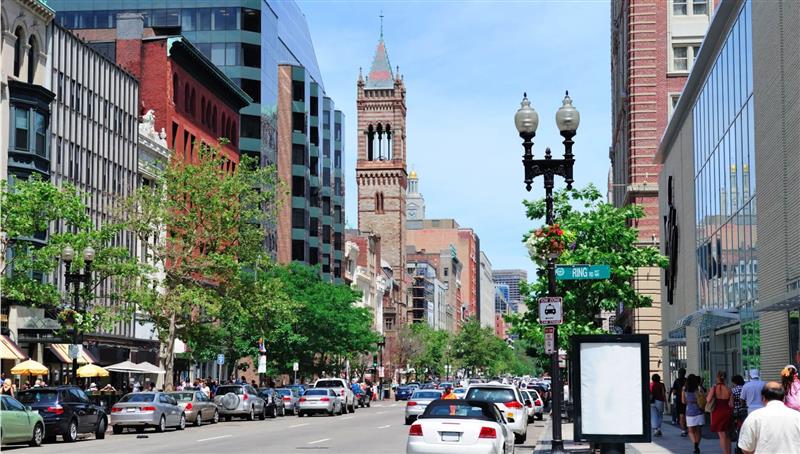
- Boston is the 3rd most walkable large city in the U.S. and has an excellent transit score, but less than 30% of commuters use public transit.
- Want to save money? It might be easier said than done, but leaving the car at home and taking the bus to work could save you $8,195.
- Want to save time? Driving to work might cost thousands of dollars each year but it saves an average of 21.2 minutes every day, adding up to nearly 4 days per year.
A recent Point2Homes study looked at how much time and money commuters, and especially renters, invest in their daily commute, focusing on the 30 largest U.S. cities. In high-density urban hubs, commuting to work seems to take either time or money, so knowing the real numbers behind their daily ride to work could help renters, who generally have lower incomes than owners, make more informed decisions.
With about 108 bus, 12 rail, 3 subway, 5 light rail and 6 ferry lines, Boston has excellent public transportation. Despite that, less than 30% of Boston’s commuters use public transit to get to and back from work. In a move that reflects America’s status as a car-centric nation, nearly half of all commuters in Boston drive to work. Using the car instead of a bus might save commuters 4 days every year, but it definitely costs. Driving to work is $8,195 more expensive than taking the bus.
Boston Renters Can Save More Than $8,000 a Year by Switching to Public Transport Instead of Driving
Boston is one of the most expensive cities in the ranking for commuting by car, with annual costs of $9,275 on average, taking fuel, maintenance, insurance, and parking into account. This means Boston is the 5th most expensive city for drivers in the study.
Meanwhile, commuters who use public transport pay just over $1,000 a month on average. While this puts Boston among the top ten most expensive cities for public transport in the study, the savings add up to $8,195 annually on average. Considering that the median monthly income for renters in Boston is $5,727, renters who ditch the car can essentially gain a little under a month and a half’s extra income each year.
Spread across the year, that works out to around an extra $680 each month to spend on rent, bills, debt repayment, or putting into savings. For renters who are feeling financially stressed, this extra cash might just provide a little more stability.
Is the Time Saved by Driving in Boston Worth the Cost?
It’s natural to think that by spending over $8,000 more each year on commuting costs, there would be a large payoff in terms of the time saved. However, in Boston, this isn’t necessarily the case. Bostonians who drive to work typically spend around 77 minutes a day on the road, the third-longest car commute of the cities studied. Meanwhile, the average commute time for public transit users is just over 98 minutes, the 8th longest time in the rankings.
While both commute times are long compared to some of the other cities studied, the difference between driving and taking public transportation in Boston is just a little over 21 minutes. Over the course of a year, this adds up to just under 4 extra days spent traveling to work. Either way, the difference is quite small, and sees Boston second in the rankings, with only Washington, D.C. seeing a shorter time difference between driving and taking the bus.
Of course, there are other benefits to driving, such as flexibility. But, for a saving of around 20 minutes each day, the cost is quite high.
How Easy Is It To Travel by Public Transportation in Boston?
Boston is the third most walkable large city in the U.S., and most errands can be accomplished without the use of a car. Downtown neighborhoods are naturally the most walkable, but even the least walkable suburbs, such as Readville and Fairmount Hills, still benefit from a fair walk score. The city also boasts a high bike score, with decent infrastructure throughout the city.
As such, Boston isn’t a particularly car-dependent city. On top of that, the city enjoys excellent public transit. The city is home to America’s first subway system, operated by the MBTA (Massachusetts Bay Transportation Authority), which is also responsible for the bulk of public transit options in Boston.
The MBTA provides a mix of subway lines, bus routes, commuter rail services, and ferry routes in and around the Boston Metropolitan Area and beyond. In particular, the commuter rail lines serve a huge area, making travel to and from Downtown easy from the suburbs.
All in all, with such a comprehensive public transit system at an affordable price, switching from driving to public transportation is a fantastic way for renters to save a huge chunk of cash each year.
Methodology
Point2Homes.com is a real estate listing portal for rental homes across the United States. Part of Yardi Systems, Point2Homes covers housing trends and news through comprehensive studies that draw from internal data, public records, governmental sources, and online research.
- For this study, we took into consideration the 30 most populous U.S. cities, per the U.S. Census American Community Survey (ACS 2023).
- Data about means of transportation to get to work, tenure by vehicles and commute time for the 30 largest U.S. cities were also sourced from the U.S. Census American Community Survey (ACS 2023).
- Data on fuel and maintenance costs was sourced from AAA, car insurance costs from Bankrate, and parking rates from Spothero.
- Data on the financial cost of public transit commuting in each city was sourced from APTA and local transit authority websites.
- The median income for the renter and owner households at the national level and also for the 30 cities used in the analysis were sourced from the U.S. Census American Community Survey (ACS 2023).
- Image credit: Songquan Deng / Shutterstock.com
Fair use and redistribution
We encourage and freely grant permission to reuse, host or repost this article. When doing so, we only ask that you kindly attribute the authors by linking to Point2Homes.com or this page, so that your readers can learn more about this project, the research behind it and its methodology.
