

Finding houses for rent that tick all the right boxes is never easy. For renters with disabilities, however, the search can sometimes feel almost impossible.
That’s why it’s so important for disabled renters to fully understand their rights when looking for suitable housing. From making accommodation requests to overcoming common obstacles, knowing the laws and regulations that protect renters with disabilities is key to securing a safe and accessible home.
Renting with a Disability
In the U.S., a person is considered to have a disability if they have a physical or mental impairment that substantially limits one or more major life activities. According to the Centers for Disease Control and Prevention (CDC), about 1 in 4 adults in the U.S. lives with some form of disability. Despite this, renters with disabilities continue to face significant challenges when searching for suitable housing.
Below are just some of the most common issues and potential strategies to help in trying to overcome them:
1. Landlord Discrimination
It is illegal for a landlord to deny housing to a renter because of a disability. While penalties vary depending on the case, violations can result in serious legal and financial consequences for landlords. Unfortunately, discrimination is not always obvious, and some landlords may attempt to sidestep the law in more subtle ways:
- Steering applicants to certain units rather than showing all available properties. Renters have the right to view all units for which they qualify, not just those a landlord deems “suitable.”
- Pretending a unit is no longer available to avoid having to make potentially expensive upgrades to the property: speak with neighbors to verify if the unit is occupied or request more information from the realtor.
- Asking intrusive questions about the tenant’s disability, such as whether it will hinder their ability to pay the rent on time: landlords are not to ask such questions, and renters are not obligated to answer them.
- Denying an application to someone with a support animal because the property is not pet-friendly: support animals are not classed as pets under the Fair Housing Act. A doctor’s letter can explain why a support animal is necessary.
This kind of discrimination can be reported to the U.S. Department of Housing and Urban Development.
2. Lack of Accessible Features
Depending on the type of disability, renters may need specific features to ensure their home is safe, accessible, and comfortable. Unfortunately, many rental properties — especially those in older buildings — are not equipped with essentials such as accessible parking spaces, wheelchair ramps, wide doorways, lowered or reachable light switches and outlets, or elevators. However, renters do have the right to request accommodations or modifications to help make a unit more accessible.
3. Lack of Affordable Options
Affordable accommodation is increasingly difficult to find, particularly for people with disabilities, who often have an income on the lower end of the spectrum. For renters whose sole income is from the Supplementary Security Income (SSI), it can be extremely challenging to find a suitable place to live independently.
However, many states offer an additional supplement to bolster the federal SSI, and it may be worth checking what’s available. Local public housing agencies may also be able to help subsidize housing costs. Unfortunately, local public housing agencies generally suffer from long waiting lists. An alternative is to apply directly to low-income developments using specialized sites.
Understanding the Rights of Renters with Disabilities
With an idea of just some of the challenges that renters with disabilities can face, it’s time to look at the rights they can exercise.
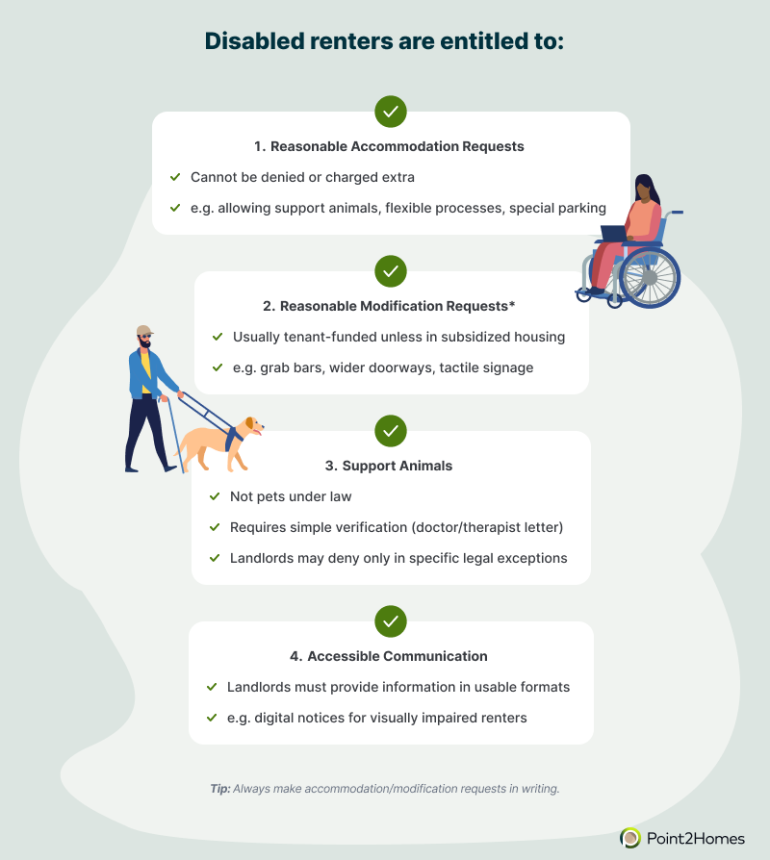
1. Reasonable Accommodation Requests
Disabled renters have the right to ask for reasonable accommodations that will allow them to enjoy their home in comfort and safety. These accommodations can also extend to any common or public spaces in the building. Essentially, a reasonable accommodation request is an exception or change to a rule or service.
Examples of reasonable accommodation requests include:
- Allowing a support animal to live in a no-pet property
- Providing a designated parking spot closer to the rental unit
- Being more flexible on the application process
Such requests can be made verbally, but it’s always best to get them in writing to ensure there’s a solid record. Landlords cannot charge additional fees or deposits for accommodating such requests.
2. Reasonable Modification Requests
Alongside reasonable accommodations, renters with disabilities are entitled to make modification requests. A reasonable modification is defined as a structural change that enables a disabled renter to fully enjoy their home. Renters can be required to pay for such modifications, although in federally subsidized housing, the costs are typically covered.
Typical examples of reasonable modification requests include:
- Widened doorways
- Grab bars in bathrooms and other areas
- Braille stickers
- Modified appliances
Landlords do have the right to deny modification requests that would place an unreasonable burden on them. For example, requesting the installation of an elevator in a small building.
3. Reasonable Accommodations for Service Animals
Service, assistance, or support animals are defined as animals that assist, provide emotional support, perform tasks, or alert their owners when something is wrong, for people with disabilities. Under the Fair Housing Act, they are not classified as pets. As such, it’s reasonable for a renter who depends on a support animal to request that the animal can stay with them in the rental unit.
For someone who is visually impaired, a seeing-eye dog is a fairly obvious service animal. However, less obvious relationships can be easier for landlords to dismiss, such as an emotional support cat for someone who is suffering from PTSD.
A service animal is generally defined as:
- An animal that the renter relies on to help them with their disability.
- An animal that the renter wouldn’t be able to comfortably live without and manage their disability.
Renters may need to provide information detailing why they need the service animal to live with them. Normally, a doctor’s or therapist’s letter stating that the tenant is disabled and that the specific animal is needed to help treat or manage the disability. They don’t need to give details such as what the disability is or what the service animal does to help treat it. Furthermore, renters don’t need to show any evidence that the animal has received training in any form.
4. Effective Communication Methods
Renters with disabilities have the right to have all information provided to them in a way that they can understand. For example, notices or flyers may be sent digitally to visually impaired renters so that they can use text-to-speech software to read them. Additionally, braille signs may be installed in common areas.
Tips for Finding a Rental That Ticks the Right Boxes
With a clearer understanding of the rights that renters with a disability have, as well as the challenges they may face, let’s look at how to find a rental that works.
1. Use Specialized Listing Services
It’s usually easier to find a rental that already accommodates the needs of the renter. Some listing websites focus only on showcasing accessible housing.
2. Work With Advocacy Groups
For those struggling to find an appropriate space, help can be found at advocacy groups such as Volunteers of America. Such organizations offer a wealth of online resources that can help find a suitable place to live.
3. Visit in Person
It’s always best to tour any potential rental in person to get a good idea of whether it offers everything required.
4. Organize Paperwork
Proof of income is a necessity when applying for most rentals. Those who rely on disability and housing benefits are advised to request the required paperwork in advance to avoid delays with applications.
This article is intended for informational purposes only and does not constitute legal, financial, or housing advice. Rental laws, disability rights, accessibility requirements, and housing assistance programs can vary based on federal, state, and local regulations. Renters with disabilities who are seeking houses for rent should consult with a qualified attorney, local housing authority, disability rights organization, or other licensed professional to receive guidance tailored to their specific circumstances and jurisdiction.
Image: U. J. Alexander; mentalmind/Shutterstock.com
