
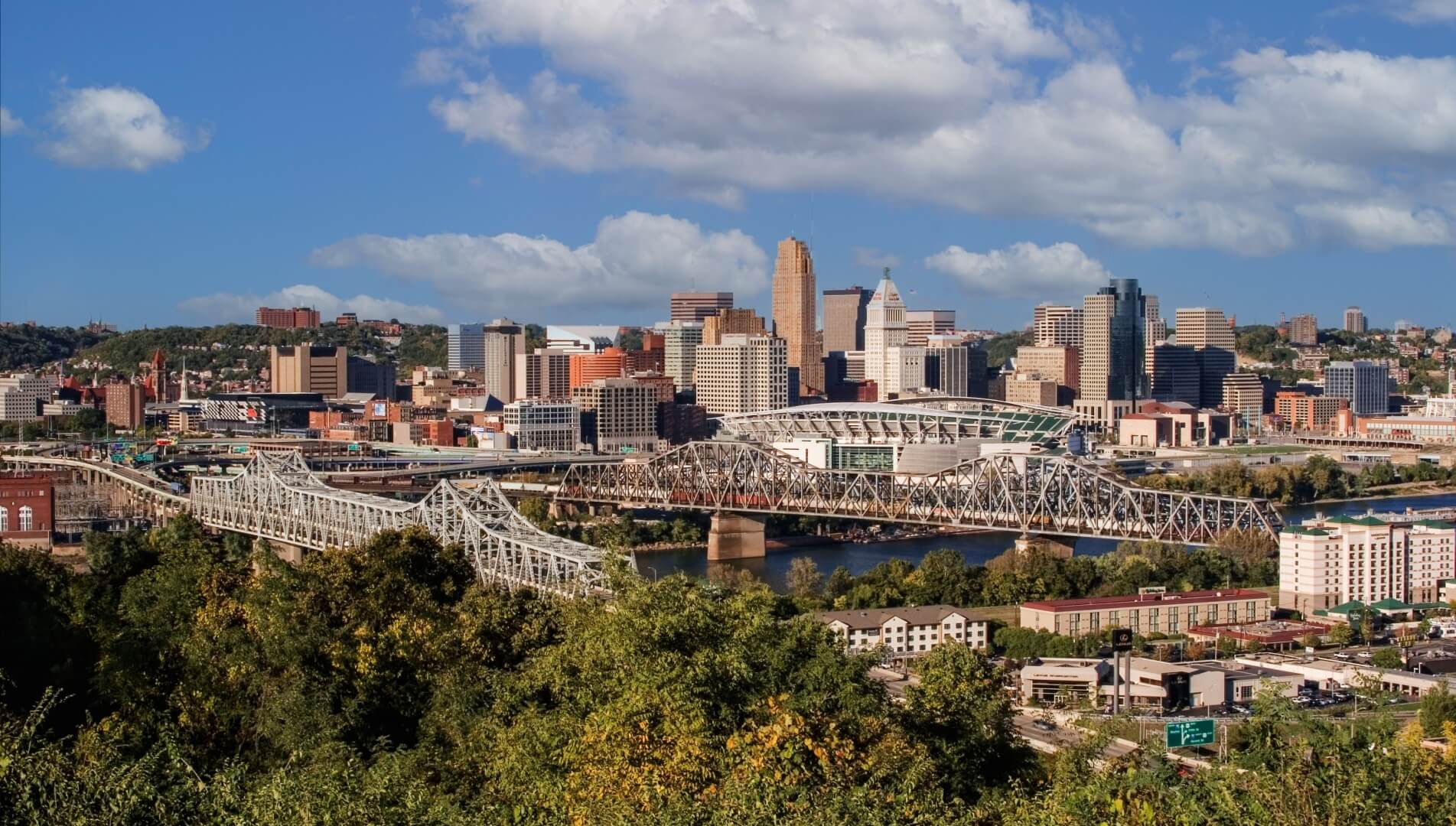
Situated at the confluence of the Licking and Ohio rivers, Cincinnati is Ohio’s third most populous city. The city serves as an economic and cultural hub for the tri-state area, and was historically a bustling river port.
Surrounded by rolling hills, the city is steeped in history, with the architecture to match. Plus, with a solid job market, there are a lot of pros for renters considering a move to the city. But is it a good choice for those reliant on public transport to get around?
In this guide, we’ll take a good look at the various public transit options in Cincinnati.
What Public Transit Options Are There in Cincinnati, OH?
The Southwest Ohio Regional Transit Authority (SORTA) is the primary provider of public transport in and around Cincinnati, with a small number of services provided by the Transit Authority of Northern Kentucky (TANK).
1. METRO Bus
Metro Bus is the main option for public transit users in and around Cincinnati. Operated by SORTA, Metro offers around 50 fixed bus routes, with a mix of local, cross-city, and express services. Seven key routes boast 24/7 services, with a fleet of modern buses offering free Wi-Fi, charging ports, and sleek, new bus stops.
Two bus rapid transit (BRT) services are also in the works, with plans to go live in 2028. The existing routes are mostly centered around downtown, with excellent services in the city center. Outside of the central hub, services are less frequent and stops are farther apart. Having said that, routes cover the entirety of the city, with park and ride options for areas with fewer stops.
2. MetroNow!
MetroNow! is an on-demand service aimed at providing public transport for those in areas with limited options. The app enables users to book a ride within specific zones, connecting them to the wider public transit network.
The service runs weekdays between 6 am and 9 pm, and weekends between 8 am and 9 pm, and costs $2.50 per ride.
3. Streetcar – The Connector
While the city once relied on streetcars as the main form of public transit, Cincinnati is now served by a single streetcar line known as the Connector. It operates on a 3.6-mile loop between The Banks in Downtown and Finlay Market in the Over-the-Rhine neighborhood.
With 18 stops along the way, the Connector provides easy access to a wealth of Cincinnati sites and attractions, and is popular among visitors and residents alike. It’s free to use and runs from 7:30 am until 11:30 pm on weekdays, 8:30 am to 11:30 pm on Saturdays, and 9:30 am until 9:30 pm on Sundays.
4. Cincinnati Red Bike
Cincinnati Red Bike is the city’s main bike-share program, boasting 70 bike stations across the city and a fleet of more than 700 bicycles. Riders simply need to install the app and pay as they go, with 2-hour slots as standard. The bikes are dotted throughout the city, with stations in Northern Kentucky as well.
Accessibility on Cincinnati’s Public Transport
All fixed-route Metro buses offer accessibility features, such as low floors and wheelchair ramps, as well as a kneeling feature that enables the bus to drop closer to the sidewalk. Buses also offer reserved areas for wheelchair users and priority seating at the front.
Additionally, announcements are both visible and audible, ensuring everyone knows when their stop is coming up. Service animals are also allowed on board for free. Metro also offers a paratransit service called Access.
How Much Does Public Transport Cost in Cincinnati, OH?
A one-way fare on local bus routes costs $2.20 and $3 for express routes. Regular riders can make big savings by purchasing a pass, with several options to choose from for ultimate flexibility. Day passes cost $4.40 for unlimited travel on local routes for 24 hours, $5 for Metro and TANK services, and $6 for express routes.
Metro also offers 30-day passes, which cost $88 for local routes, $120 for express routes, and $105 for Metro and TANK services. A new Tap&Save program makes it cheaper and easier to travel on the go, with daily and monthly price caps matching the costs of the passes.
Red Bike prices start at $12 for a two-hour pass, plus $5 for every additional hour. Meanwhile, a monthly pass is $30, while an annual pass costs $150, both offering unlimited 2-hour trips for the duration. The Go-Pass is a $5 monthly pass aimed at qualifying riders with a household income below 200% of the federal poverty guidelines.
