

Life can be unpredictable and even the best-laid plans can go wrong occasionally. For tenants, late rent payments can be a source of extreme stress. The fear of eviction paired with embarrassment at the situation can cause many to try to simply hope the problem will go away.
However, there are far more effective ways to handle late rent payments and tenants facing a missed due date have numerous options. In this guide, we’ll take a look at the best ways for tenants to deal with late rent payments.
What Are the Consequences of Late Rent Payments?
First of all, it’s worth discussing the consequences of missing a rent payment. In many cases, these consequences will never come to fruition, as long as the tenant takes the necessary steps to prevent escalation.
However, if they don’t, they can expect their landlord to report their late payments to the credit bureaus, which can result in the tenant’s credit score taking a huge hit. In addition, the tenant is likely to lose a positive landlord reference which would’ve helped secure future rentals. Together, these two hits can make it difficult to rent in the future.
There are also other, more immediate consequences. In the worst-case scenario, landlords can have their tenants evicted for continuous late payments. More commonly, however, tenants will be hit with late fees.
And, according to the latest data from the Consumer Financial Protection Bureau, there are quite a few renters who are in this situation. The percentage of renters who incurred a late fee in the past year increased after 2021, reaching its highest point in 2023 before starting to decline. In September 2021, just over 15 percent of renters were behind on rent and had a late fee, but this figure rose, reaching a peak of 23 percent by February 2023. Since then, the percentage has decreased, with approximately 14 percent of renters in November 2024 having incurred a late fee in the previous 12 months.
Analyzing the age groups who are most prone to be behind on rent, it’s the 40- to 54-year-olds and also the renters in the 55-64 age group who are the most likely to have problems covering their monthly rent:
Understanding Late Fees
Landlords will often impose late fees if the tenant pays the rent even just a few days later than agreed. The good news is that in most places, late fees are legally capped, while in others they’re not allowed at all. Late fees must be detailed in the lease agreement and if there’s no mention of them, tenants are not legally required to pay any kind of penalty for paying the rent late.
If there is a late fee clause in the agreement, it’s a good idea to check local laws and regulations to see what can legally be charged. In general, landlords cannot set an unreasonably high late fee and they must usually allow a grace period of a few days. In most cases, late fees will amount to around 5% of the rent.
Immediate Steps to Take If You Miss a Payment
With an idea of what’s at stake should a tenant be late with a rent payment, here’s what to do if a late payment is unavoidable.
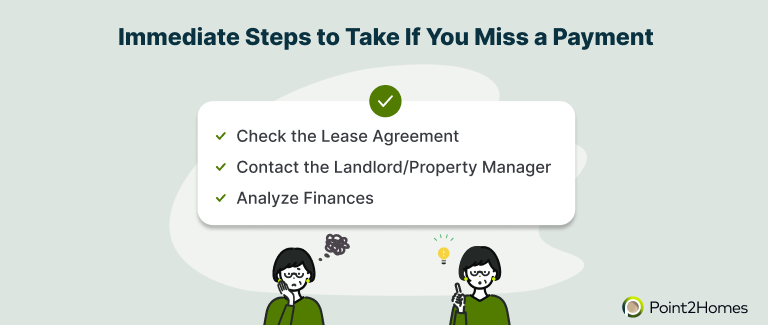
1. Check the Lease Agreement
First and foremost, tenants are advised to double-check the lease agreement to see the exact terms and conditions around rent payment. It’s a good idea to confirm the amount owed and what the exact due date is. Next, take a look at any late payment fee clauses.
2. Contact the Landlord/Property Manager
As soon as the tenant knows they’re going to be late with their rent, they need to let the landlord or property manager know. There are many good reasons for a late payment, such as a misplaced paycheck, a medical emergency, or even an unexpected cost that leaves money tighter than usual. More often than not, landlords are willing to be flexible with good tenants.
By not communicating the issue and simply missing the deadline, the landlord is likely to assume the worst. But, by notifying them in advance, tenants show initiative and awareness of their commitments.
3. Analyse Finances
Now is also a good time for tenants to take an honest look at their financial situation. Is this a one-off caused by unusual circumstances, or does it look like it could become a longer-term problem, with repeated late or even missed payments?
The answer to that question will largely dictate what to do next. For example, if the rent is no longer affordable due to the tenant losing their job, there’s a good chance they’ll need to move to somewhere more affordable or drastically change their lifestyle.
Meanwhile, if it’s just a one-time issue, things are somewhat easier to manage. Either way, the next sections detail how to avoid recurring late payments.
5 Ways to Avoid Late Payments in the Future
Gaps in the rent can be bridged in several ways. In the short term, tenants have various options to choose from.
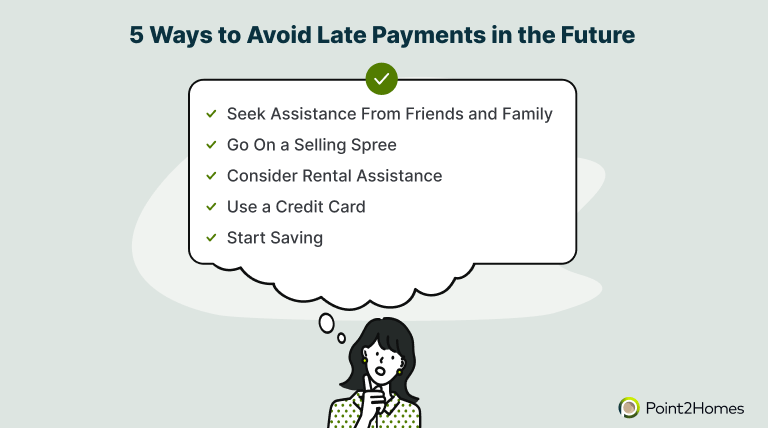
1. Seek Assistance From Friends and Family
Family members or even close friends may be able to help tenants out of a temporary tight spot. Arranging an informal yet sensible loan in this way avoids high interest rates and it’s easier to figure out a repayment plan that works for both parties. With careful planning, late payments can be avoided altogether, along with the risk of losing a positive landlord reference.
2. Go On a Selling Spree
Most people have at least a few items they may be able to sell. It’s not an ideal solution, but it can certainly help in a pinch. Nowadays, it’s easier than ever to sell a huge array of goods quickly and easily, with minimal fees.
It doesn’t have to be limited to material goods either. Stocks, shares, or even unused credit card points could all be cashed in to help cover the rent in the short term.
3. Consider Rental Assistance
Most parts of the country have rental assistance programs in place to aid those who are struggling to pay the rent. These emergency rental assistance programs typically provide short-term assistance and could be ideal for covering a brief shortfall in earnings. Charity and nonprofit organizations may also be able to offer assistance to renters in need.
4. Use a Credit Card
For tenants who know that they have funds on the way, paying the rent with a credit card could be a useful last resort. It’s important to ensure the landlord will allow credit card payments and to proceed cautiously. Failure to pay off the card before the high interest rates hit could lead to much bigger problems.
5. Start Saving
The best way to avoid future late payments is to start building a safety blanket of savings. Putting a bit of cash aside each month can soon yield results, ensuring that the next time the rent is due and funds are low, there’s something in the pot to help cover it.
How to Handle Repeated Late Payments
If rent will be late for an extended period, the previous short-term solutions probably won’t be enough to keep tenants afloat. Losing a job or forking out on an expense that makes future rent payments impossible may mean the tenant has no choice but to leave the rental and seek out somewhere more affordable.
In this case, it’s important to discuss this with the landlord. Explain the situation thoroughly and see if they can terminate the lease early, or perhaps assign it to someone else. There’s a chance they may have a cheaper property available that would be a better match.
Be aware that should tenants terminate the lease early, they may be hit with break fees. In many cases, the landlord may be happy to negotiate a payment plan to cover the outstanding rent, as well as any late and break fees.
For tenants on a month-to-month lease, be sure to check how much notice must be given.
Renegotiating the Rent Terms
An alternative solution is to attempt to renegotiate the rent terms with the landlord. It’s unlikely they’ll drop the price, but they may be able to offer an extension and waive any late fees. Tenants can offer to pay at least a portion of the rent on time, with the rest following by a set date.
Be sure to get any agreements made with the landlord in writing, preferably signed by both parties. In case of a later eviction notice, the agreement can be used as evidence that the landlord was aware of the situation and had agreed to an alternative payment schedule.
Image credit: Miljan Zivkovic, bebe3, tokumiyanuts / Shutterstock.com
