
The monthly Point2Homes Build-to-Rent Single-Family Homes Market Report is powered by Yardi Matrix data.
April SFR Market Insights:
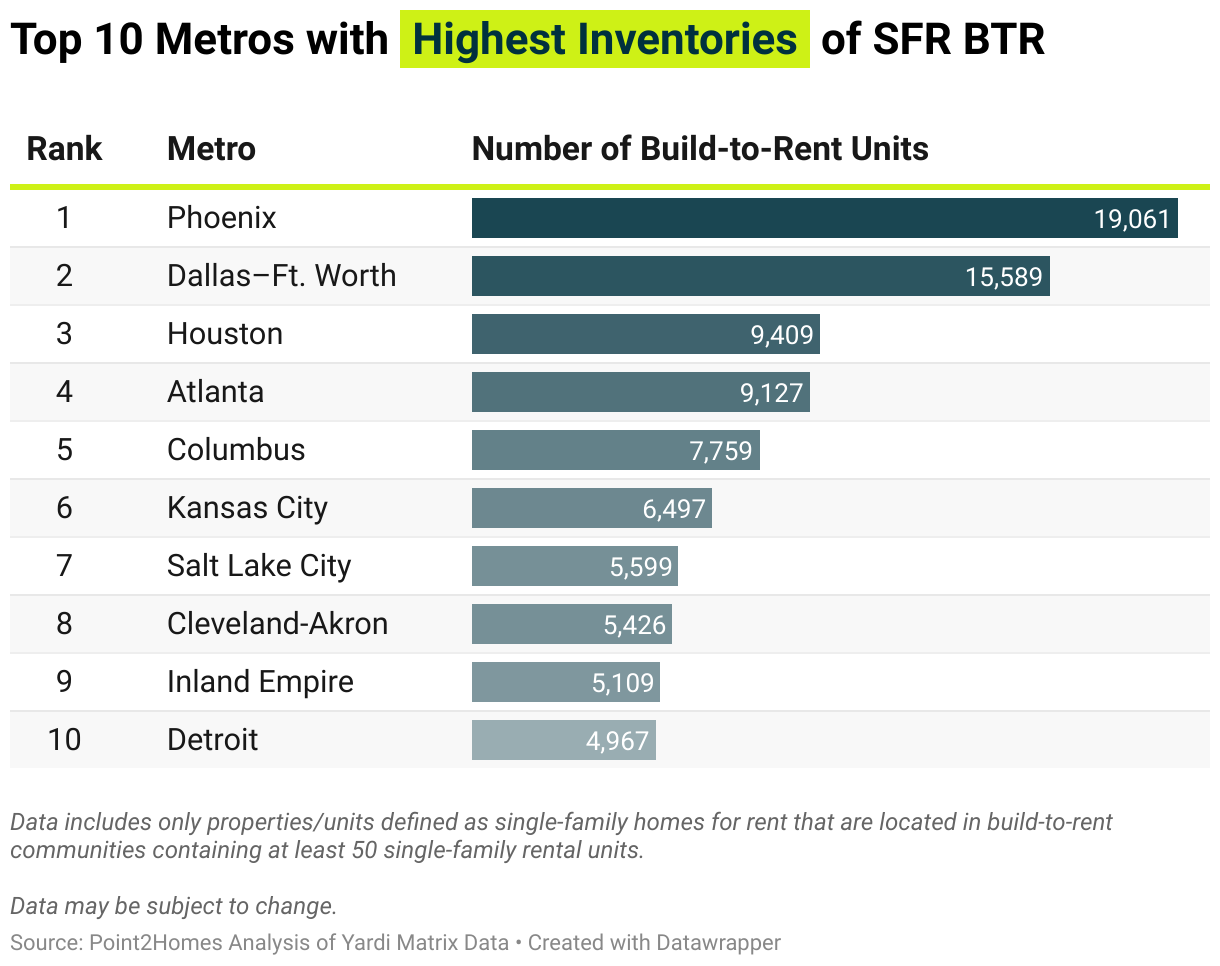
- In April, nine U.S. metros had 5,000 units or more in single-family build-to-rent communities with 50 or more units. BTR stock remains concentrated in high-growth Sun Belt metros such as Phoenix (19,061 SFR units), Dallas–Ft. Worth (15,589), Houston (9,409), and Atlanta (9,127).
- Rents dropped in half of the nation’s major markets in April, with Sun Belt cities like Austin (-4.4% y-o-y), Phoenix, and Dallas among the steepest declines.
While the build-to-rent market remains resilient, the latest projections suggest that activity will taper off in the near future. Rising construction costs and ongoing labor shortages are expected to slow the sector’s exponential growth, with the latest data from Yardi Matrix projecting a 44.5% drop in national completions by 2027 compared to 2025.
Even so, demand remains strong. As homeownership becomes increasingly unaffordable and renters continue to seek more space, developers are pressing ahead with new single-family rental communities. According to the April Yardi Matrix report, the BTR SFR market maintains strong momentum with a stock of nearly 230,300 single-family units nationwide.
Build-to-Rent Activity Strongest in Phoenix as Sun Belt SFR Supply Expands
The BTR sector continues to account for a significant share of new rental supply, with current single-family home developments expected to sustain steady delivery volumes through 2025.
As per Yardi Matrix, “The wave of supply will continue to suppress rent growth until the new units are absorbed, with a slowdown in completions anticipated in the coming years.” In 2025, Phoenix, AZ, alone is projected to add 7,144 new SFR units, which represents 1.9% of its total rental stock. Dallas, TX, is forecast to see 3,164 new units (0.3% of total stock), while Austin, TX, is expected to add 1,353 units (0.4%).
Nine out of the ten metros with the highest SFR BTR inventories are located in the Sun Belt, with Phoenix at the forefront, boasting over 19,000 built-to-rent houses. The area continues to be a hotspot for BTR investment, driven by strong in-migration, job growth, and sprawling land availability to sustain construction demand.
Rent in Half the Nation’s Major Markets Declined in April
According to Yardi Matrix, April advertised rent dropped in 15 out of 30 metros, while the year-over-year growth was flat at the national level. Single-family rental markets in the Sun Belt are facing the sharpest year-over-year rent declines, with nine of the ten metros seeing the lowest drops located in the region.
Austin, Phoenix, and Dallas stand out for both their significant projected supply growth in 2025, as well as declining rents. Rents in Austin have dropped 4.4% year-over-year, Phoenix has seen a 3.2% decline, and Dallas rents are down 2.1%. Together, these drops, plus the influx of new supply, are expected to moderate rent growth, potentially flattening rent trajectories in the near future.
As reported by Yardi Matrix, Detroit and Inland Empire are among the few markets to record a year-over-year increase in advertised rents for single-family rentals exceeding 5%. In both areas, strong demand has kept pressure on rents: In Detroit, growing interest in higher-quality rental housing and renewed economic activity have driven prices up, while in Inland Empire, spillover demand from Los Angeles continues to push rents higher.
Methodology
Point2Homes.com is a real estate listing portal for rental homes across the United States. Part of Yardi Systems, Point2Homes covers housing trends and news through comprehensive studies that draw from internal data, public records, governmental sources, and online research.
This report is based on data provided by our sister company, Yardi Matrix. The data includes single-family build-to-rent communities of 50 homes and larger. A Yardi Matrix market generally corresponds to a Standard Metropolitan Statistical Area (SMSA), as defined by the United States Bureau of Statistics.
